 New arrivals
 Desert boots
 Ankle boots
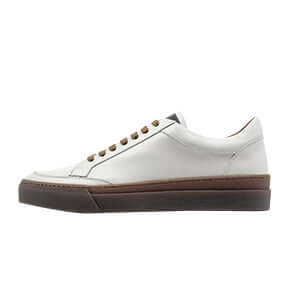 Sneakers
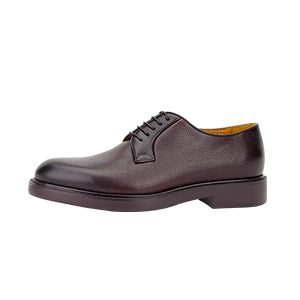 Derby
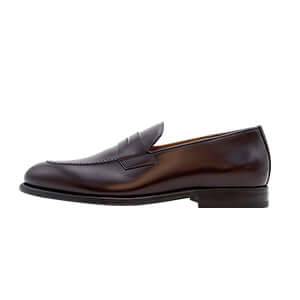 Loafers
 Oxfords
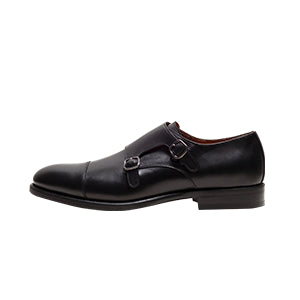 Double monk straps
 Last pairs
 New arrivals
 Ankle boots
 Loafers
 Derby
 Oxfords
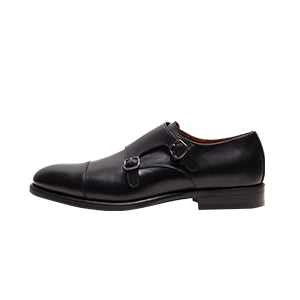 Double monk straps
 Last pairs
 Belts
 Shoe care
 Insoles
 Men's socks
 Shoelaces
 Gadgets

History of the Derby: the most versatile English shoe
Before asking whether a Derby is elegant enough for a dress, it is best to untie the laces. The answer to his luck is there: in the two flaps that open above the foot. A small construction change gave the classic shoe more edge, without taking away its composure.
Its story can be read as that of a wardrobe that learns to adapt to the wearer. With a clarification: more adjustable does not automatically mean more comfortable. A good idea must meet a good form.
1872: a shoe described with the foot in mind
Crockett & Jones reports a description published in 1872 by St Crispin's: the Derby was appreciated because it left more freedom to the foot, even in summer. It is a concrete clue, much more useful than an overly certain date of birth. Model origins have multiple reconstructions; the famous tale of the Earl of Derby should be treated as tradition, not as a birth certificate.
That document also tells us something current: comfort is not a recent invention. The shoemakers were already discussing stitching, pressure and space. Materials change; foot questions remain surprisingly similar.

The detail that separates Derby and Oxford
In the Derby, the cuffs carrying the eyelets are sewn onto the upper: the lacing is open. In the Oxford the closure is more gathered, because the cuffs enter under the front part. Just follow the base of the laces with your gaze to read the difference.
Blucher: a relative with a different cut
In the catalogs Derby and Blucher can be synonymous. When distinguished precisely, in the Blucher the eyelets are carried by smaller elements applied on a more continuous upper. Both have an open closure. Better to observe the cut than argue with the label: the terminology is not identical for all producers.
Three surfaces, three ways to wear it
Let's look at our shoes. Venezia in brushed leather has a bright and composed surface: with wool and clean trousers it easily finds its balance. Lucca in suede instead works on the texture, making the transition to dark denim and knitwear more natural. Bellagio adds the full brogue design: the perforations change the character, not the lacing.


The degree of formality arises from the combination of colour, shape, background and decoration. A dark and thin smooth Derby can be more composed than a chunky and highly decorated Oxford. Families help with orientation; the single pair decides the outcome.
The decisive test is done by walking
The opening allows you to adjust the instep, but does not correct a narrow sole or an incorrect length. Try both shoes with your usual socks. If the heel moves even when tightened a lot, ask for a different shape: the knot must not solve the project.
Before purchasing, also ask how the sole is mounted and whether it can be replaced. Derby describes a shape, not a construction: stitching and gluing cannot be deduced from the name. It's an unspectacular question that becomes valuable after much walking.
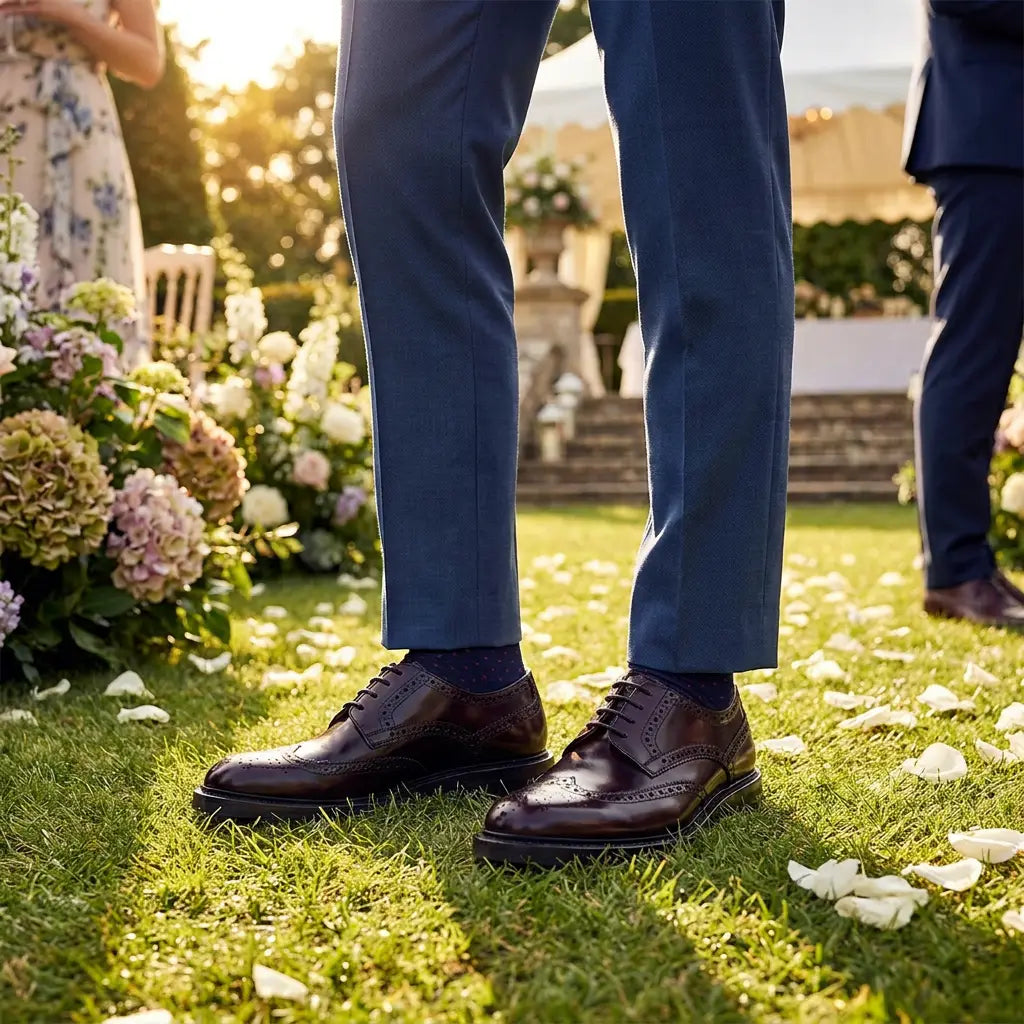
The desktop image is an illustrative composition adapted with artificial intelligence from a catalog photo.